
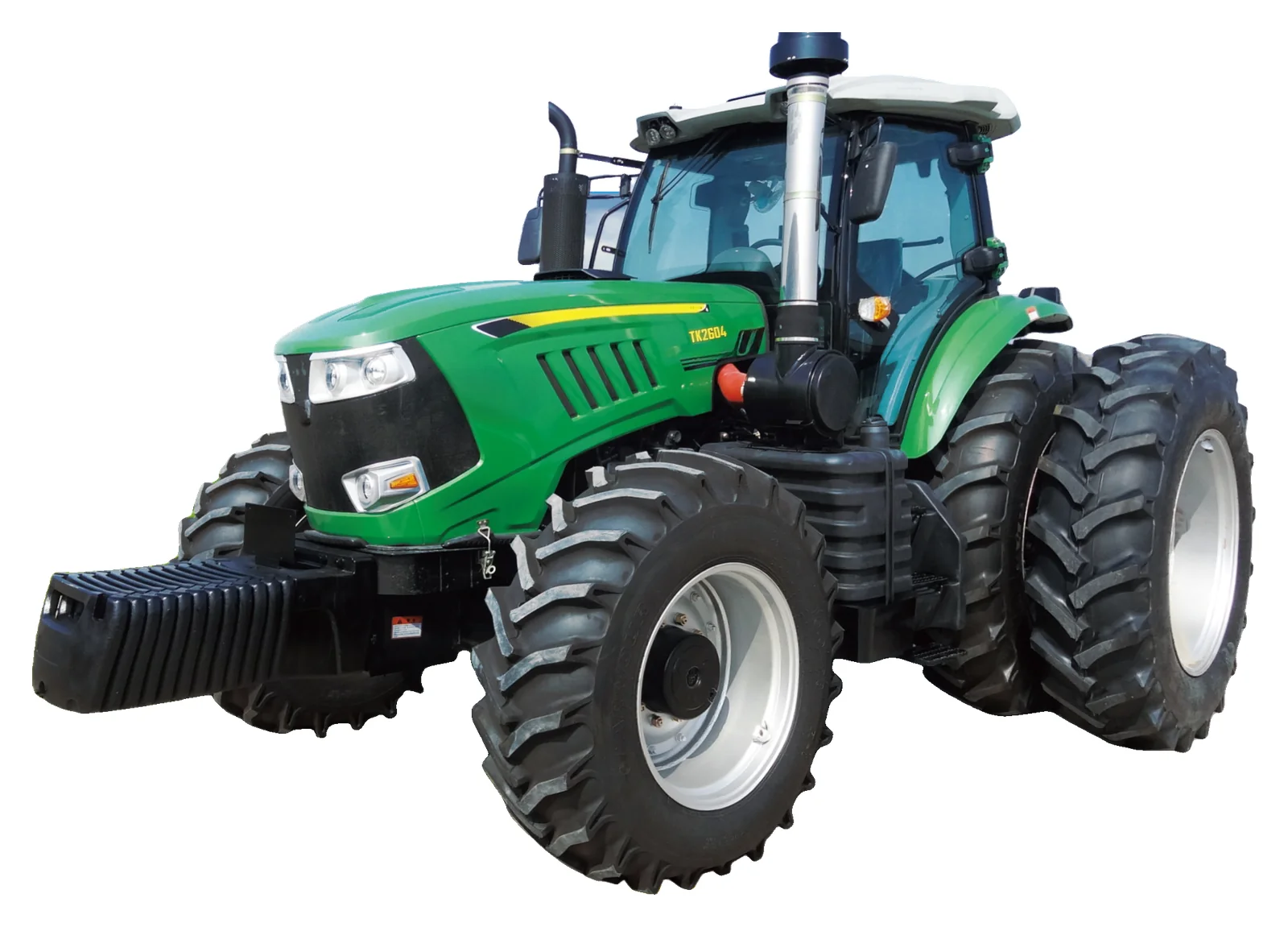
Key points
- The TK series' 50–260 HP are calculated from engine power; according to UGA, the rear PTO typically delivers 75–85% of rated engine power, and the drawbar gets even less.
- Choose for the heaviest task: in loam soil, plowing at 20 cm and 7.2 km/h, each meter of plow requires about 29.5 drawbar HP, about 47 PTO HP, about 59 engine HP.
- Check PTO shaft speed before ordering: ISO 500-1 specifies 540 and 1000 r/min (also 1300); most TK models list 720, 760 or 850 r/min, and only some models or options offer 540 or 1000.
- Minimum operating mass is not the working weight: heavy drawbar work usually requires ballast according to PTO HP, without exceeding the maximum weight shown on the safety frame or cab plate.
First distinguish three powers: engine, PTO and drawbar
Horsepower on a tractor data sheet is usually engine power. On this site’s TK series, HP are calculated from engine kW—for example, the TK1204 has 88.2 kW and is listed as 120 HP. Engine power passes through the transmission and rear axle to the PTO, then through tires and soil to become drawbar power; each step involves losses. UGA materials state that a diesel tractor's rear PTO generally delivers 75–85% of rated engine power. MSU materials set, by ground condition, the share of PTO HP that can be sustained for drawbar work as 62.5% on firm ground, 55% on worked ground, and 47.5% on freshly plowed soil (after accounting for transmission, rolling resistance, slip and about a 17% overload reserve).
| Item | Estimated value | Basis |
|---|---|---|
| Engine rated power | 88.2 kW ≈ 118 hp | Published value (120 is in metric horsepower) |
| Rear PTO power | ≈ 89–101 hp | UGA: 75–85% of engine rated power |
| Sustained drawbar on firm soil (untilled stubble) | ≈ 55–63 hp | MSU: PTO horsepower × 62.5% |
| Tilled ground | ≈ 49–55 hp | MSU: PTO HP × 55% |
| Freshly plowed soil | ≈ 42–48 hp | MSU: PTO HP × 47.5% |
FAO and INTA publications point in the same direction: on a two-wheel-drive tractor, drawbar power is about 60% of PTO power; with front-wheel assist (smaller front wheels than the rear), it is about 65–68%. All 13 TK models are four-wheel drive with smaller front wheels than the rear, that is, front-wheel assist.
ImportantThe estimates in this guide narrow the selection; they are not a performance guarantee. The actual width a tractor can pull depends on soil moisture, slope, tires, ballast and the operator, and should be confirmed by a field test or local experience.
How to estimate HP by implement width
MSU bulletin E-1152 gives drawbar HP required per foot of working width. The table converts that to per meter and, following MSU examples, assigns the ground the tractor travels on: plow, chisel plow and heavy disc harrow on firm ground; the first tandem disc harrow pass on freshly plowed soil; and the field cultivator on worked ground. “Engine HP per meter” assumes the PTO delivers 80% of engine power.
| Work (speed) | Drawbar HP per meter | PTO HP per meter | Engine HP per meter |
|---|---|---|---|
| Moldboard plow, depth 20 cm, sandy soil (7.2 km/h) | 17.7 | 28.3 | ≈ 35 |
| Moldboard plow, depth 20 cm, loam (7.2 km/h) | 29.5 | 47.2 | ≈ 59 |
| Moldboard plow, depth 20 cm, clay loam (7.2 km/h) | 41.3 | 66.1 | ≈ 83 |
| Chisel plow (7.2 km/h) | 28.2 | 45.1 | ≈ 56 |
| Heavy disc harrow (7.2 km/h) | 24.6 | 39.4 | ≈ 49 |
| Tandem disc harrow, first pass after plowing (6.4 km/h) | 11.8 | 24.9 | ≈ 31 |
| Field cultivator (8.9 km/h) | 11.5 | 20.9 | ≈ 26 |
MSU examples converted to metric: a 60 PTO-hp tractor working loam at 20 cm depth and 7.2 km/h can sustain about 37.5 drawbar hp, enough for a plow about 1.27 m wide, i.e. a 3-bottom 16-inch plow (1.22 m); a 4-bottom 14-inch (1.42 m) plow would overload it. Conversely, a 2.44 m (8 ft) tandem disc harrow on freshly plowed ground at 6.4 km/h requires about 29 drawbar hp, i.e. about 61 PTO-hp.
- Increasing speed by 10% raises required power by more than 10% (MSU); the table values correspond to the listed speed.
- Choose for average annual conditions, not the toughest single field; but don’t undersize on purpose—continuous overload speeds engine wear and increases slip and fuel consumption.
- The values come from extension materials for U.S. field conditions. In Latin America’s heavy clay soils, volcanic soils or high-altitude areas the differences can be large; verify with your local agricultural service or experience from similar operations.
From area and available days back to implement width
UGA recommends selecting in five steps: identify the most critical, highest-resistance task; estimate how many days are available to do it; compute the hectares per hour that must be covered; determine implement working width from that; and finally infer tractor power from the implement’s drawbar pull. Example converted to metric: 24.3 ha of sandy soil, worked twice with a tandem disc harrow and only 5 workdays of 8 h, requires 1.21 ha per hour. At 8 km/h that needs a harrow about 1.83 m wide, with a drawbar force of about 1,000 kgf and 29.4 drawbar HP; for loose or sandy soil UGA multiplies drawbar HP by 2.1, giving about 62 PTO HP. If speed is reduced to 5.6 km/h, about 43 PTO HP is sufficient, but with the same width the hectares covered per hour drop and the schedule lengthens.
For PTO-driven implements, UGA estimates PTO HP by working width or material throughput, for example:
- Disc mower: about 6.6 PTO HP per meter.
- Flail mower: about 13.5 PTO HP per meter.
- Rotary mower (blades rotate in a horizontal plane): about 34.1 PTO HP per meter.
- Small square baler: about 3.9 PTO HP per tonne per hour; large round baler: 5.6–6.7.
For rotavators, stubble mulchers and other implements common in the region, use the PTO power rating specified by the implement manufacturer as the reference.
PTO: 540 / 1000 r/min versus 720 / 760 / 850 in the TK series
ISO 500-1 (adopted in the U.S. as ANSI/ASABE AD500-1) classifies rear PTO speeds: type 1 at 540 r/min, types 2 and 3 at 1000 r/min, and type 4 at 1300 r/min. FAO and INTA publications also list common spline sizes: 35 mm with 6 splines for 540 r/min, and 35 mm with 21 splines or 45 mm with 20 splines for 1000 r/min. Implements designed to these standards will state 540 or 1000 r/min on their nameplate.
Not all PTO speeds published for the YUYAN TK series are 540 or 1000. According to this site’s product pages:
| Published PTO speed (r/min) | Model | Meaning for 540 / 1000 implements |
|---|---|---|
| 540 / 720 | TK504、TK604 | Has 540 position |
| 720 | TK504A | No 540 or 1000 position |
| 540 / 760 | TK1004 | Has 540 position |
| 760 / 850 | TK1204、TK1404A、TK1604、TK1604A、TK1804 | No 540 or 1000 position |
| 540 / 1000 or 760 / 850 | TK2104、TK2404、TK2604 | Specify 540 / 1000 version on the order |
| 760 / 850, 540 / 760, 540 / 1000 or 760 / 1000 | TK2104A | Choose the combination according to the implements |
MSU notes that PTO work requires maintaining a constant PTO speed; you cannot close the throttle and shift to a higher gear as with light towing. To reduce a 760 r/min PTO to 540 r/min, the engine would operate at about 71% of its rated speed and cannot deliver its rated power; that does not replace the correct PTO specification.
ImportantIf you already have implements, send the PTO speed and spline specification from the nameplate or manual, and we will match the TK model and PTO option that we can supply directly. If you plan to buy implements as well, choose them to match the tractor’s selected PTO speed.
YUYAN TK series in three power ranges
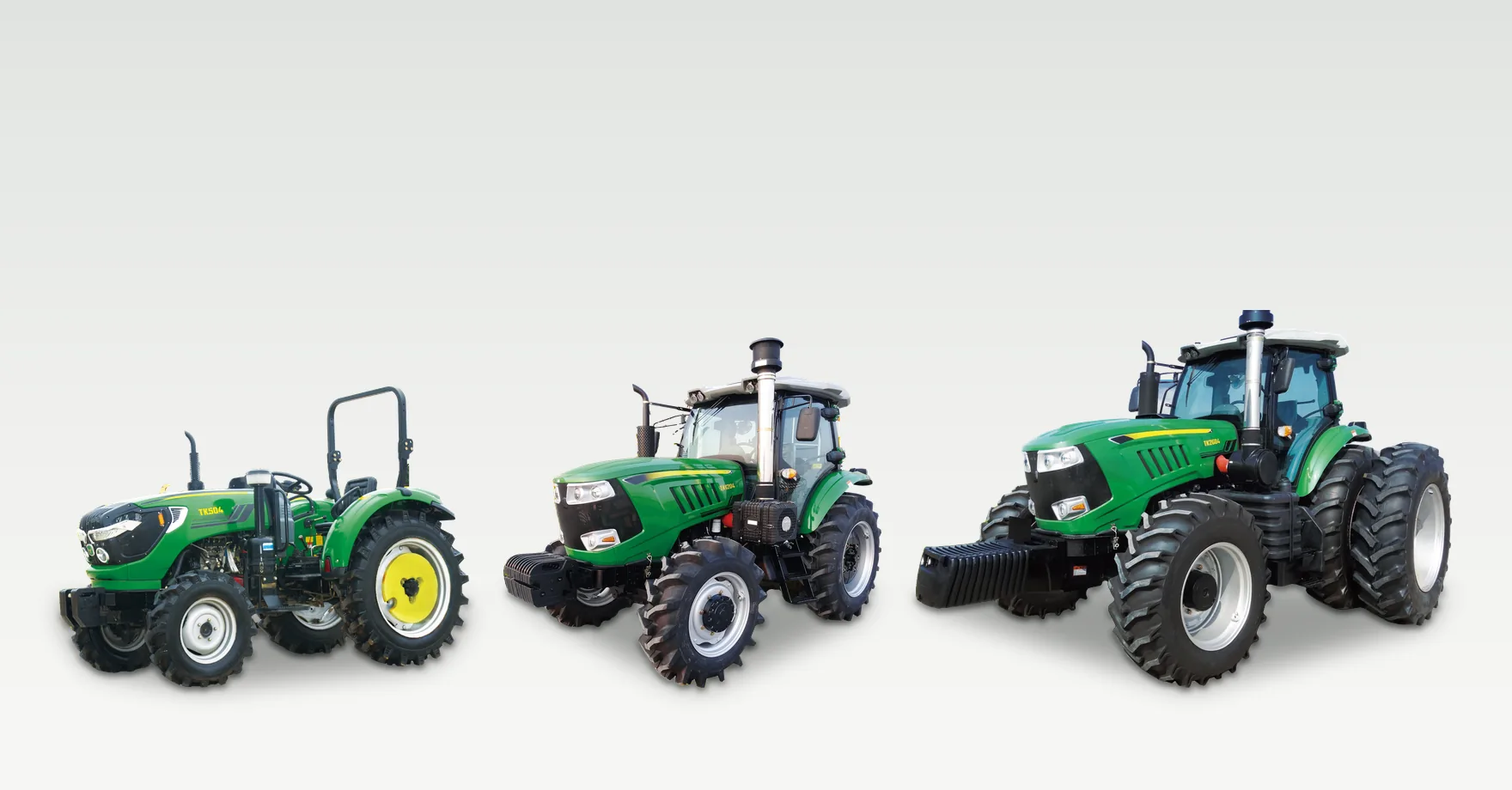
All 13 TK tractors are four-wheel drive. The three compact models—TK504, TK504A and TK604 (50–60 HP)—use an 8+2 gearbox, have an open safety frame, and offer adjustable front and rear track width; their compact size suits small operations and narrow spaces. TK604 supports external hydraulic equipment such as a front loader or rear backhoe, and TK504A can be configured with single or dual hydraulic outlets.
The three mid-size models, TK1004, TK1204 and TK1404A (100–140 HP): the TK1004 has 12+12 shuttle-shift transmission and PTO 540/760; the TK1204 uses a dual-cylinder high-pressure lift and a larger-displacement lift pump, and its cab can be specified with fan, air conditioning, or heater; the TK1404A has a fully enclosed cab with optional air conditioning, heater and audio.
The seven high-horsepower models, TK1604, TK1604A, TK1804, TK2104, TK2104A, TK2404 and TK2604 (160–260 HP), are aimed at large-area farming; according to the product sheet, the TK2104 can work with heavy-duty implements for stubble shredding, plowing, deep tillage, subsoiling, seedbed preparation and seeding. The TK2104, TK2404 and TK2604 have 16+16 gearing and optional PTO 540/1000; the TK2404 offers draft control, position control and combined draft/position control; the TK2604 is equipped with an SDEC electronic common-rail engine, CARRARO front drive axle with hydraulic differential lock, Trelleborg radial tires and an electro-hydraulic lift control system.
| Model (HP) | Engine power / gears | PTO(r/min) | Maximum drawbar pull / minimum operating mass |
|---|---|---|---|
| TK504(50) | 36.8 kW / 8+2 | 540/720 | 13,300 N / 1,690 kg |
| TK504A(50) | 36.8 kW / 8+2 | 720 | 10,400 N / 1,420 kg |
| TK604(60) | 44.2 kW / 8+2 | 540/720 | 13,400 N / 1,690 kg |
| TK1004(100) | 74 kW / 12+12 | 540/760 | 15,200 N / 2,845 kg |
| TK1204(120) | 88.2 kW / 16+8 | 760/850 | 34,700 N / 4,730 kg |
| TK1404A(140) | 105 kW / 16+8 | 760/850 | 36,100 N / 4,920 kg |
| TK1604(160) | 117.6 kW / 16+8 | 760/850 | 34,700 N / 4,730 kg |
| TK1604A(160) | 118 kW / 16+8 | 760/850 | 36,100 N / 4,920 kg |
| TK1804(180) | 132.5 kW / 16+8 | 760/850 | 40,500 N / 5,515 kg |
| TK2104(210) | 154.4 kW / 16+16 | 540/1000 or 760/850 | 47,100 N / 6,410 or 7,200 kg |
| TK2104A(210) | 154.4 kW / 16+8 | Multiple combinations (see the table in the previous section) | 43,200 N / 5,890 kg |
| TK2404(240) | 177 kW / 16+16 | 540/1000 or 760/850 | 50,700 N / 6,900 or 7,730 kg |
| TK2604(260) | 191.5 kW / 16+16 | 540/1000 or 760/850 | 56,800 N / 7,735 kg |
| Model | Estimated PTO horsepower | Plowing in loam (20 cm, 7.2 km/h) | Tandem disc harrow, first pass after plowing (6.4 km/h) |
|---|---|---|---|
| TK504 | 37–42 | 0.8–0.9 m | 1.5–1.7 m |
| TK604 | 44–50 | 0.9–1.1 m | 1.8–2.0 m |
| TK1004 | 74–84 | 1.6–1.8 m | 3.0–3.4 m |
| TK1204 | 89–101 | 1.9–2.1 m | 3.6–4.0 m |
| TK1404A | 106–120 | 2.2–2.5 m | 4.2–4.8 m |
| TK1804 | 133–151 | 2.8–3.2 m | 5.4–6.1 m |
| TK2104 | 155–176 | 3.3–3.7 m | 6.2–7.1 m |
| TK2604 | 193–218 | 4.1–4.6 m | 7.7–8.8 m |
PTO horsepower is estimated as 75–85% of engine power; plowing uses 62.5% of available traction on firm ground and the first harrow pass 47.5% on freshly plowed ground. Clay‑loam plowing width is about 70% of loam; sandy soil about 1.7 times.
Ballast: minimum operating mass is not working weight
K‑State notes that traction efficiency is usually best with tire slip of 8–15%, with a target near 12%: too little slip indicates excess ballast and too much wastes power and fuel. Its optimal whole‑tractor weight for front‑assist tractors (at 80% load) is about 63.5 kg per PTO horsepower at 6.4 km/h, 52.2 kg at 8 km/h and 43.1 kg at 9.7 km/h.
Estimated for heavy draft at 8 km/h: TK1204 would need about 4,630–5,240 kg and lists minimum operating mass 4,730 kg, near the lower end; TK604 about 2,320–2,630 kg versus 1,690 kg; TK2604 about 10,050–11,390 kg versus 7,735 kg. In other words, most models will need front ballast, wheel weights or tire ballast for heavy draft; lighter, faster PTO‑driven work does not require so much weight.
- Static weight distribution with front‑assist drive: about 40% front / 60% rear for towed implements and about 45% front / 55% rear for mounted implements (K‑State).
- For heavy-duty work below 6.4 km/h, K-State does not recommend relying on ballast alone.
- With added ballast, total weight must not exceed the maximum on the ROPS or cab certification plate, and must remain within the load ratings of the tires and axles.
- Radial tires typically increase productivity by 2–6% and reduce fuel consumption by 6–8% (K-State); the TK2604 uses Trelleborg radials.
Hitch, hydraulics, track width and cab
- Three-point hitch: FAO and INTA list four standardized categories; implement hitch pins must match the tractor category. Control can be draft, position, or draft/position combined. The TK2404 offers all three; the TK1604A and TK2104A have position and float control; the TK2604 has electronic lift control.
- Hydraulic outlets: first count how many circuits the implement needs (for example, a hydraulic reversible plow or hydraulic markers), then confirm the tractor’s number of outlets and flow. The TK504A accepts single or dual outlets; the TK1604A and TK2104A have hydraulics with independent supply.
- Track width: the TK504 front track is adjustable in steps at 950 / 1150 / 1250 mm and the rear is stepless 960–1300 mm; the TK2104, TK2404 and TK2604 have a rear track of 1,700–2,300 mm. For row crops, set the track to match row spacing to avoid crop damage.
- Cab: the three compact models have open rollover protection; the TK1204 cab can be fitted with a fan, air conditioning, or heater; the TK1804, TK2104 and TK2604 have enclosed cabs with air conditioning, and the TK2404 includes air conditioning as standard. In hot or dusty areas, consider an enclosed cab, which the spec sheet notes reduces dust and noise.
FAO and INTA also note that, among similar models, dealer and service proximity, parts availability, and maintenance support often matter more than a few HP. When requesting a quote, include a list of common wear parts and your preferred supply method.
Before import: emissions and local requirements
The TK series engine is marked China III emissions, which refers to China’s Stage III standard for non-road mobile machinery; it is not equivalent to an EU Stage IV / V certificate. These are the non-road emission provisions related to farm tractors in three countries, as checked by this site in November 2026:
| Country | Rule | Relevant provision for agricultural tractors |
|---|---|---|
| Chile | DS 39/2020 (amended by DS 33 in 2024) | Does not apply to agricultural machinery other than tractors; applies to tractor imports from 1 January 2030, limits equivalent to EU Stage IV / V, and engine type or family certificate required before import |
| Mexico | NOM-174-SEMARNAT-2026 (effective 18 November 2026) | Numeral 1.2.3: machinery intended for the agricultural sector is excluded |
| Colombia | Res. 762/2022; Res. 683/2026 (applies from 31 December 2026) | The current text excludes nonroad mobile sources intended exclusively for agricultural work; the amendment adds a condition to the exception for refrigeration or air‑conditioning systems using controlled substances, and its scope is open to interpretation—if the tractor has an air‑conditioned cab, confirm with your customs broker whether it remains exempt |
The table covers emissions only. Taxes, registration, safety requirements, machine cleaning and other import requirements must be confirmed item by item with your local customs broker before placing an order.
ImportantYUYAN can assist in providing engine and machine documentation, preparing export paperwork, and coordinating information needed for customs clearance and local import admission; approval, clearance timing and local registration are determined by the destination country authorities, and YUYAN does not guarantee them.
What to specify when requesting a quotation
| Item | What should be written down |
|---|---|
| Model and engine | Model, engine brand and model, rated power (kW) and emissions stage |
| Transmission | Number of gears (for example, 8+2, 12+12, 16+8 or 16+16) and type of transmission |
| PTO | PTO speed combinations and spline specification, consistent with your current or planned implements |
| Three-point hitch and hydraulics | Hitch category, type of lift control and number of hydraulic outlets |
| Cab | Open ROPS or enclosed cab, and whether air conditioning, heater or other options are included |
| Tires, track width and ballast | Tire size and type (bias or radial), track width settings, and type and weight of included ballast |
| Tools and spare parts | Included tools, list of wear parts and how follow-up parts are supplied |
| Data | Operation and maintenance manual, parts catalog and language |
| Price and delivery | FOB loading port, quantity, validity of the quotation, delivery time and shipping method |
| Warranty | Warranty scope and period — subject to the written contract |
This site does not publish tractor prices. Send the type of work, soil, the implements you use most and their widths, PTO speed, destination port and quantity, and YUYAN will provide a written quotation based on the actual configuration.
Frequently Asked Questions
How many HP does a farm tractor need?
Area alone won’t define it. First identify the heaviest, most time‑critical task, calculate how many hectares per hour you must cover given the available days, choose the implement width, and finally estimate the PTO HP based on implement draft and soil. Sections 2 and 3 of this guide show the MSU and UGA conversion methods.
What plow width can a 50 HP tractor pull?
Using the method in this guide, a 4×4 50 HP tractor such as the TK504, plowing at 20 cm depth and 7.2 km/h, works about 0.8–0.9 m in loam soil (equivalent to a two‑bottom 16‑inch plow); about 1.3–1.5 m in sandy soil; and about 0.6 m in clayey loam. Actual results depend on soil moisture, ballast and field trials.
Can I use 540 or 1000 rpm implements with a tractor whose PTO is 760 rpm?
Not recommended. PTO work requires a stable nominal speed; reducing engine speed to drop a 760 r/min PTO to 540 r/min prevents the engine from delivering its rated power. Choose a model or option with 540 or 1000, for example the 540 position on the TK504, the TK604 or the TK1004, or the 540/1000 versions of the TK2104, TK2404 or TK2604.
Are the TK series two‑wheel drive or four‑wheel drive?
The 13 YUYAN TK tractors listed on this site are 4×4, with smaller front wheels than rear wheels — i.e., front‑assist four‑wheel drive.
Does an imported tractor have to meet Stage V?
It depends on the destination country. According to the provisions checked in November 2026, Chile’s emissions requirements for tractors apply to imports from 1 January 2030; Mexico’s NOM‑174 does not apply to agricultural machinery; and Colombia’s agricultural exception acquires additional conditions from 31 December 2026. The TK series is marked China III emissions; have your customs broker confirm requirements before ordering.
How much does a YUYAN tractor cost?
This site does not publish tractor prices. Price depends on model, cab, PTO, tires, ballast, quantity and destination port. Request a written quotation.
Sources consulted
- Michigan State University Extension, bulletin E-1152: matching tractor horsepower to implement size (in English).Michigan State University Extension
- University of Georgia Cooperative Extension, ENG07-003: what size tractor does your farm need (in English).University of Georgia Cooperative Extension
- Kansas State University: getting the most efficiency from your tractor (in English).Kansas State University Research and Extension
- FAO and INTA: Which tractor to choose? Comparison parameters for agricultural wheeled tractors (in Spanish).FAO Regional Office for Latin America and the Caribbean
- ANSI/ASABE AD500-1:2014 (equivalent to ISO 500-1), preview (in English).ANSI Webstore
- Ministry of Environment (Chile): Decreto 39/2020, current non‑road emissions text (in Spanish)Biblioteca del Congreso Nacional de Chile
- Diario Oficial de México: NOM-174-SEMARNAT-2026 (in Spanish)Diario Oficial de la Federación
- Ministry of Environment (Colombia): Resolución 762/2022 original text (in Spanish)Ministerio de Ambiente y Desarrollo Sostenible
- Colombian government legal register: Resolution 683/2026 and the amendment’s effective date (in Spanish)Área Metropolitana del Valle de Aburrá
External sources explain general rules; specific taxes, permits and contractual conditions depend on the destination country authority and the written contract.
With the target model and destination port, the next step is to verify the specific equipment and the quotation.
Submit your purchase request ↗Back to the purchasing guide ↗